




When you’re cooking a dish, you rarely rely on a single ingredient to do all the work. A pinch of salt brings out flavour. A bit of spice adds heat. Another masala balances it out. Each ingredient plays a role, and together they shape how the dish turns out. Add too much or too little of any one thing, and the outcome changes.
In the world of trading, a strategy works in a similar way.
Instead of placing a single trade and leaving everything to chance, traders often combine multiple trades together, where each leg serves a purpose. Some reduce risk, some improve returns, and some exist purely to balance the overall position. Together, these legs form what traders call a strategy.
Understanding this layered nature of strategies was foundational to how we approached designing Ventura’s Strategy Builder.


For traders, strategies aren’t just another order type. They represent a clear view of risk, reward, and outcome. Because strategies are a combination of trades, the most critical decision-making metric becomes the payoff chart, which visualises the maximum profit and maximum loss of the strategy.

But while payoff charts help traders evaluate strategies, the path to creating one differs from trader to trader.
Trader A
Some traders prefer starting with a familiar structure and then making small adjustments. These are what we call pre-built strategies.
They are ready-to-execute setups designed for different market sentiments: bullish, bearish, neutral, or volatile. Traders can execute them as is, or tweak individual legs to better match their view.

Trader B
On the other end of the spectrum are traders who know exactly what they want to build. They prefer starting from scratch - analysing the option chain, selecting contracts, adding them to a strategy, setting prices and quantities, and executing with complete control.
Trader C
And in reality, many traders don’t strictly belong to one group. They move back and forth between pre-built and custom strategies depending on market conditions, confidence levels, and time constraints.


After speaking with traders across the company, observing how they actually build strategies, we noticed a clear pattern: some traders want full control, while others prefer a starting point.
That led us to the next question -
Where does a trader begin?
We designed the Strategy Builder landing page as more than just an entry screen. It had to act as a decision-making touchpoint.
For traders who know exactly what they want to build, the primary call to action is clear: Build your strategy. This path gives them complete control, allowing them to start from scratch and construct a strategy leg by leg.
At the same time, we surfaced pre-built strategies directly on the landing page for traders who prefer a guided starting point. These strategies came with data pre-populated for top indices, helping traders evaluate strategies quickly without the effort of setting everything up manually.
This choice also aligns with how the market behaves, as index options like Bank Nifty and Nifty 50 consistently see far higher trading volumes than single-stock derivatives, so a large portion of strategy activity naturally centres around these indices.

So we surfaced the most important information upfront:
The underlying index
The individual legs that make up the strategy
The maximum profit and maximum loss
A quick payoff visual to show how the strategy behaves
By populating live index data directly into these strategy cards, the landing page wasn't just a passive entry point. It became a space where traders could compare, evaluate, and shortlist strategies without jumping back and forth across screens.

Once we treated the landing page as a decision-making point, the next question was obvious: how much information do you show upfront before it starts getting overwhelming?
Strategies come with a lot of data by default: Underlying, contracts, prices, margins, payoff charts. So we had to be deliberate about what actually helps someone decide whether a strategy is worth opening.
As we spent more time observing how traders work, one pattern stood out: most people tend to build strategies on indices rather than individual stocks. Indices are familiar, widely tracked, and already top of mind when traders think about strategy-based trades.
At the same time, there was also a practical constraint. Pulling live data for every possible stock at this stage would require multiple API calls, potentially impacting performance.
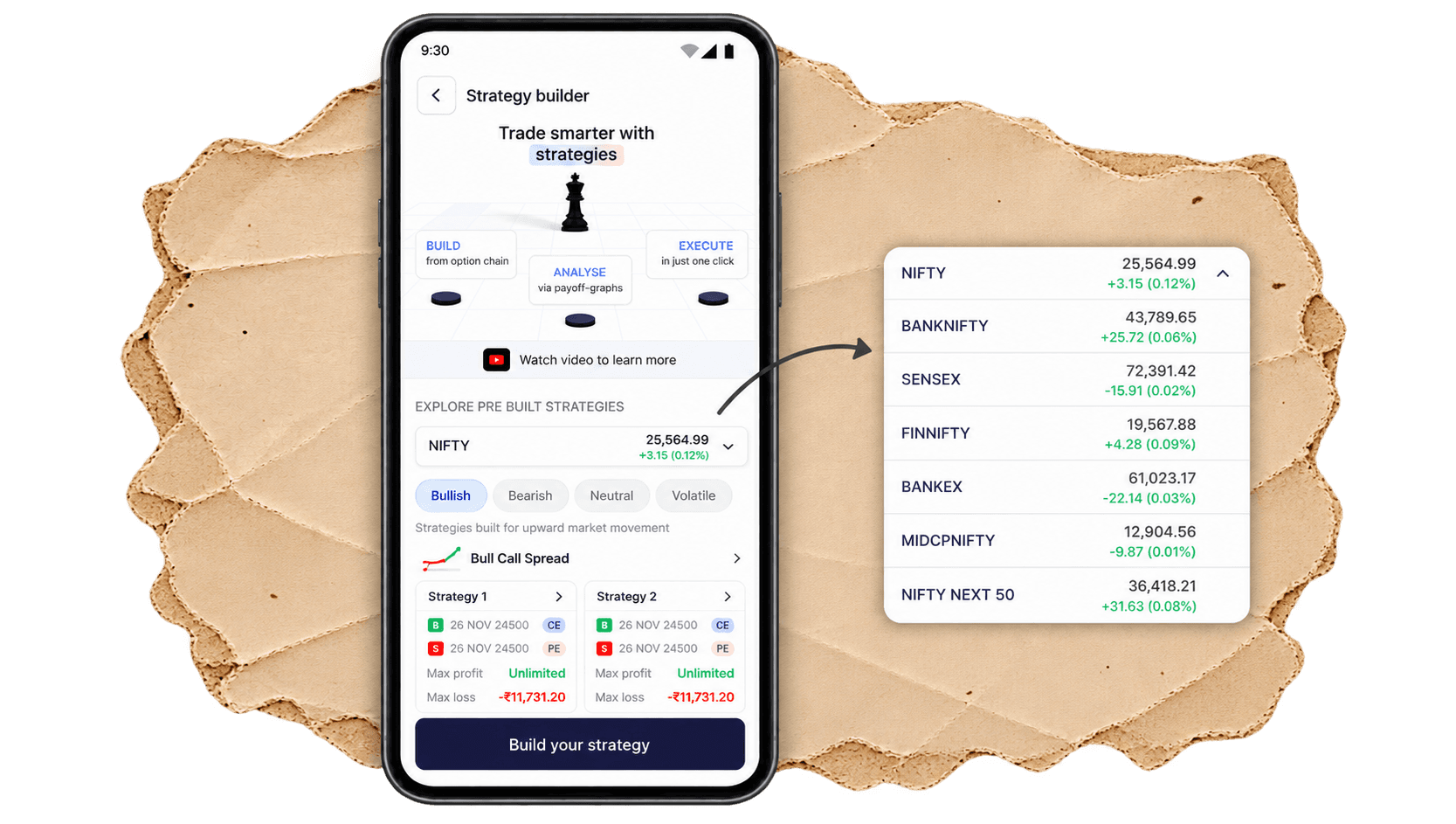
So instead of trying to show everything, we limited the landing page to a curated set of top indices and paired each pre-built strategy with just the information needed to make an initial judgement. Nothing more, nothing less.

As we spent more time observing how traders actually use strategies, one thing became very clear: not everyone uses them at the same pace.
Some traders approach strategies carefully. They add legs, pause, review everything, check the payoff, and only then move towards execution. For them, taking a moment to validate their strategy is an important part of the process.
So, initially, when we designed the flow for creating a strategy from the option chain, we assumed that the natural next step for everyone would be to preview the strategy before placing the order. It felt logical.
But this assumption only worked for one kind of trader.
There were traders who work very differently. They build strategies frequently, know exactly what they’re doing, and don’t need an extra confirmation step every time. For them, speed matters, and an additional step to 'preview' felt like friction.
Once this feedback came in, it became clear that defaulting everyone into a preview step was forcing unnecessary friction onto traders who didn’t need it. At the same time, removing the preview altogether would take away an important safety net for those who relied on it.
So instead of choosing one behaviour over the other, we chose to support both.
We introduced two clear actions at this point in the flow:
Preview strategy: for traders who wanted a final check.
Execute strategy: for traders who were ready to act immediately.
Keeping the source of truth close
When someone is building a strategy, the most important questions are always the same:
What’s my maximum profit?
What’s my maximum loss?
How much am I paying or receiving?
How does the payoff look?
The tricky part is where these questions show up.
The option chain is already a dense screen. It’s packed with prices, volumes, greeks, actions, and quick decisions. When strategy builder mode is enabled, that density only increases as traders are adding and modifying multiple contracts at once.
Pulling them away from this screen to check key metrics elsewhere didn’t feel right. It broke their flow and, more importantly, separated the decision from its context.
So instead of treating payoff and risk metrics as something you check after building a strategy, we brought them right to where the decisions were being made.


We designed a floating widget that stayed present while traders worked through the option chain. It surfaced the maximum profit, maximum loss, net premium, along with a small preview of the payoff chart. It was always visible, but never in the way.
If a trader wanted to go deeper, they could expand it and view the full payoff chart. If not, the summary was enough to keep them grounded while making changes.
Visibility at the moment of truth - the transaction widget
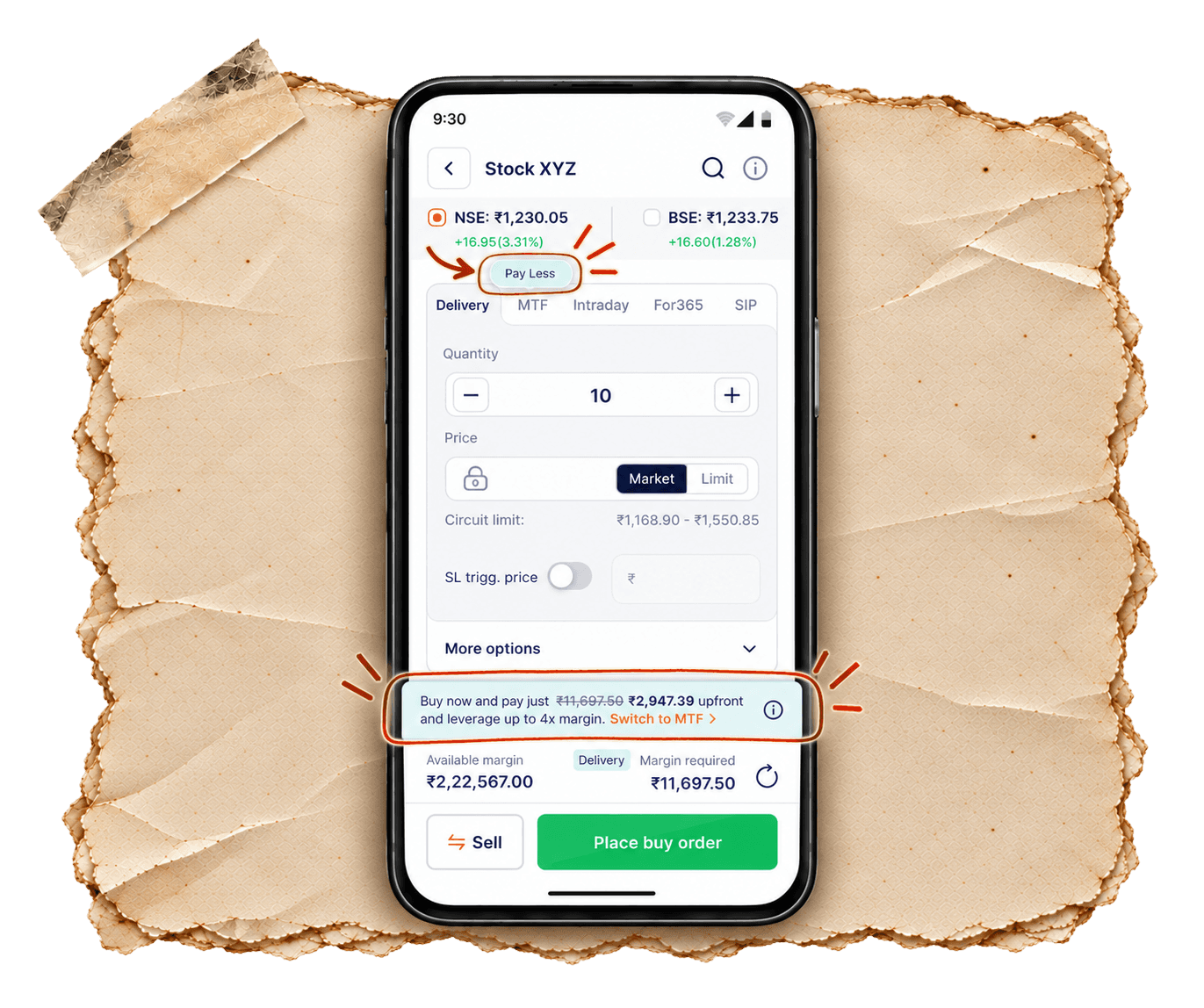
Here's something we knew about designing for the Indian audience: the "discount" model works like a charm. Whether it's a supermarket shelf flashing "Pay ₹199 instead of ₹299" or an e-commerce cart showing "You saved ₹1000 today", the psychology is universal: visible savings at the moment of truth drives action.
The Design Strategies that shaped Ventura's Strategy Builder
A multi-leg options experience that helps traders build, evaluate and execute strategies.


When every trader has a different strategy, can one experience work for all?